Wine Tasting in France
Wine Tasting in France – It’s difficult to select the region, type of wine and producer as it is hard to go wrong.
However, it would be interesting to taste Bordeaux (upper left bank, Paulliac) and Red Burgundy (Cote de Nuits).
The objective shouldn’t simply be drinking famous bottles—it should make the differences within Pauillac and the Côte de Nuits obvious.
Pauillac is particularly good for this because it has 18 classified growths, including three First Growths, and its Cabernet-dominant wines characteristically show cassis, cedar, structure and exceptional aging ability.
The Côte de Nuits gives you an almost opposite exercise: Pinot Noir expressing very small differences in village and vineyard; its Grand Crus include Chambertin, Clos de Bèze, Clos de la Roche, Clos de Vougeot, Échezeaux, Grands Échezeaux, Richebourg, La Tâche and Musigny.
Wine Tasting in France – Tasting #1 – Brodeaux’s of the Upper Left Bank (Paulliac)
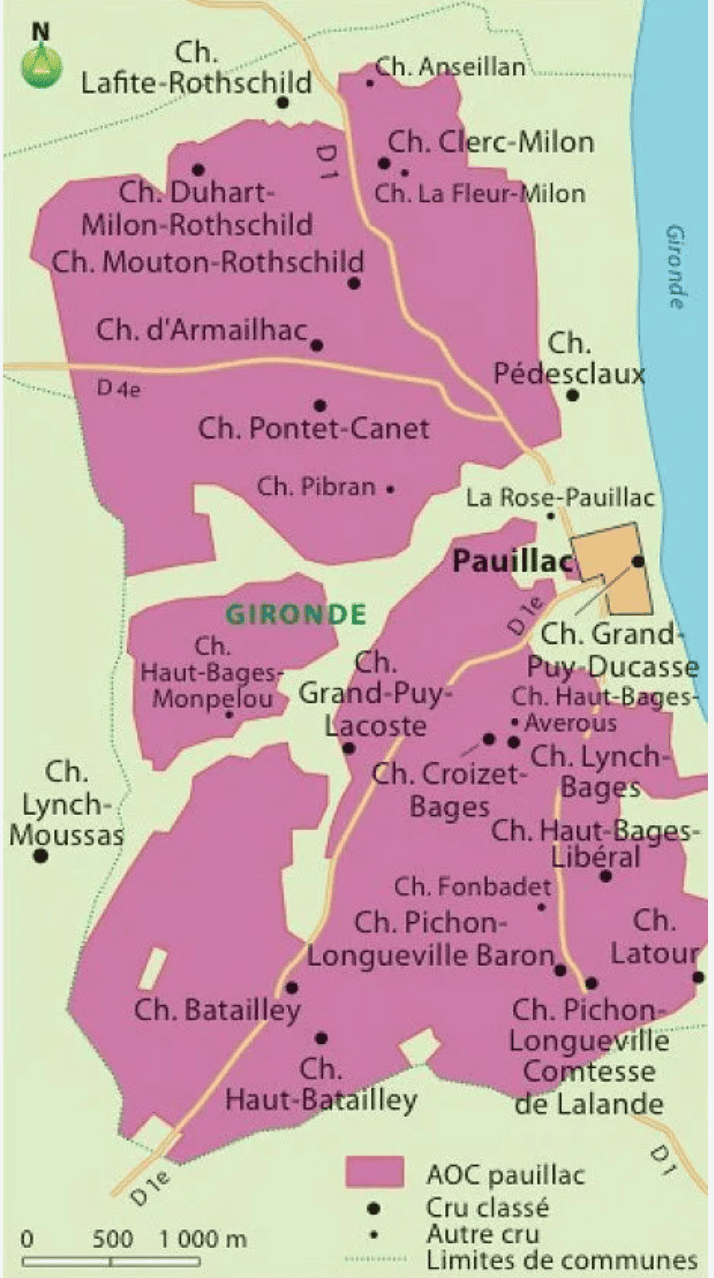
Brodeaux’s of the Upper Left Bank (Paulliac)
This would be an outstanding tasting.
Tasting Pichon Baron and Pichon Lalande side-by-side will be interesting as they are neighbors, yet their personalities can be remarkably different.
Baron Joseph de Pichon-Longueville (1760–1849) had built up the original Pichon-Longueville estate in Pauillac.
After his death, the property was divided in 1850 among his five children.
His son Raoul, who inherited the title of Baron, received the portion that became Château Pichon Longueville Baron — Pichon Baron.
His three daughters pooled their portions.
The youngest, Virginie de Pichon-Longueville, had married Henri, Comte de Lalande, making her the Comtesse de Lalande – it gets more complicated with Rauzan.
She became the driving force behind that property, which became Château Pichon Longueville Comtesse de Lalande — Pichon Lalande.
So when you’re tasting Pichon Baron vs. Pichon Lalande, you’re effectively tasting two branches of the same 19th-century family vineyard.
That’s one reason putting those two next to each other in a Pauillac tasting should highlight the difference: same parent estate, divided between brother and sisters, both classified Second Growths in 1855, but today they have noticeably different personalities.
If you want to push the tasting up another level, substitute Lafite Rothschild for Pontet-Canet and finish Lafite → Mouton.
Serve around 60–64°F, use identical Bordeaux stems, and pour roughly 2 ounces each.
Have the 2016’s opened about 2–3 hours beforehand but be conservative about aggressive decanting.
Serve them blind if your group knows Bordeaux—it will make the Pichon comparison especially interesting.
Food should be very simple: roast beef/tenderloin, lamb, mushrooms, potatoes. Nothing sweet or heavily sauced.
Wine Tasting in France – Tasting #1 – Brodeaux’s of the Upper Left Bank (Paulliac)
Pauillac: North to South
Use 2016 if you can source all six from that vintage. It’s old enough to be interesting but young enough that the terroir differences remain very clear.
Château Grand-Puy-Lacoste 2016
5th Growth
Classic, pure Pauillac benchmark
Château Lynch-Bages 2016
5th Growth
Bigger, darker, more muscular
Château Pontet-Canet 2016
5th Growth
Richness and a more modern expression
Château Pichon Baron 2016
2nd Growth
Powerful, Cabernet-driven Pauillac
Château Pichon Longueville Comtesse de Lalande 2016
2nd Growth
More aromatic, silky and refined
Château Mouton Rothschild 2016
1st Growth
The reference/trophy bottle
Wine Tasting in France – Tasting #2 – Côte de Nuits: The Progression to Grand Cru
The official Burgundy wine board counts 33 Grand Cru AOCs, 44 Village appellations and 7 Regional appellations, with hundreds of individual Premier Cru climats.
Grand Cru — The Top
This particular vineyard is considered exceptional.
The vineyard itself becomes the appellation.
The vineyard is famous enough to stand on its own.
In the Côte de Nuits, famous red Grand Crus include:
Chambertin • Chambertin-Clos de Bèze • Clos de la Roche • Clos Saint-Denis • Clos de Tart • Bonnes-Mares • Musigny • Clos de Vougeot • Échezeaux • Grands Échezeaux • Richebourg • Romanée-Saint-Vivant • La Tâche • Romanée-Conti
And here’s an important Burgundy concept: multiple producers can make wine from the same Grand Cru vineyard.
That leads to the Burgundy rule I would keep in mind:
Producer + vineyard > classification alone
A superb Premier Cru from an elite producer can easily be more desirable—and more expensive—than a Grand Cru from a mediocre producer.
The classification describes the recognized status and origin of the vineyard; it doesn’t guarantee how good a particular bottle will be.

Premier Cru — where tastings get especially interesting.
One level below Grand Cru is Premier Cru, normally abbreviated 1er Cru.
Now the label gives you both the village and the specific vineyard:
Gevrey-Chambertin = village
Clos Saint-Jacques = specific vineyard
Premier Cru = classification of that vineyard
There are some Premier Crus whose reputations are so high that Burgundy collectors regard them as being very close to Grand Cru quality.
Three Particularly Famous Examples Are:
Gevrey-Chambertin Clos Saint-Jacques
Chambolle-Musigny Les Amoureuses
Vosne-Romanée Cros Parantoux
Village
Next comes Village wine.
A bottle labeled simply:
Gevrey-Chambertin
It is made from grapes grown within the permitted Gevrey-Chambertin appellation area, but it isn’t claiming Premier Cru or Grand Cru status.
This is where the names can initially confuse people.
Gevrey-Chambertin = Village wine
Gevrey-Chambertin Clos Saint-Jacques 1er Cru = Premier Cru
Chambertin Grand Cru = Grand Cru
The reason “Chambertin” appears in the village name is historical: Gevrey added the name of its most famous vineyard, Chambertin, to the village name. That does not make ordinary Gevrey-Chambertin a Grand Cru.
The same phenomenon occurs with:
Chambolle-Musigny → Musigny is the Grand Cru
Vosne-Romanée → Romanée-Conti, Romanée-Saint-Vivant etc. are Grand Crus
Morey-Saint-Denis → Clos Saint-Denis is Grand Cru
Regional Burgundy
At the base is something such as:
Bourgogne Pinot Noir
The grapes can come from a much larger permitted area.
You don’t get the geographical precision of Gevrey, Chambolle or Vosne.
That doesn’t necessarily mean bad wine.
A great domaine can make outstanding Bourgogne Rouge, sometimes from vines surprisingly close to much more prestigious vineyards.
But officially it remains Regional Burgundy.
A Serious Côte de Nuits Tasting From Top Premier Crus From Excellent Producers Would include:
Fourrier Gevrey-Chambertin Vieille Vigne 2020
Gevrey-Chambertin
Establishes the Gevrey baseline
Duroché Gevrey-Chambertin 1er Cru Champeaux 2020
1er Cru Same village
Step up in vineyard classification
Bruno Clair Gevrey-Chambertin 1er Cru Clos Saint-Jacques 2021
1er Cru Shows what an elite “almost Grand Cru” 1er Cru can do
Robert Groffier Chambolle-Musigny 1er Cru Les Hauts-Doix 2021
1er Cru
Shift south to a more perfumed, silky expression
Hudelot-Noëllat Vosne-Romanée 1er Cru Les Suchots 2020
1er Cru
Vosne spice, richness and texture
Grand Cru — Pierre Girardin Echezeaux 2021
Grand Cru
Finish with the top classification
Six Bottle tof Red Burgundy to Buy (250-$500 Price Range)
Order, Wine Village, Target Vintage, Approximate Current Price
1 Domaine Duroché Gevrey-Chambertin 1er Cru, Champeaux Gevrey-Chambertin, 2020, $280–385
2 Domaine Fourrier Gevrey-Chambertin 1er Cru Cherbaudes, VV Gevrey-Chambertin, 2020/21, $335–425
3 Robert Groffier Chambolle-Musigny 1er Cru, Les Hauts-Doix Chambolle-Musigny, 2020/21, $260–315
4 Hudelot-Noëllat Vosne-Romanée 1er Cru, Vosne-Romanée 2019–21, ~$300–500
5 Bruno Clair Gevrey-Chambertin 1er Cru, Clos Saint-Jacques Gevrey-Chambertin, 2021, ~$375
6 Pierre Girardin Echezeaux, Grand Cru, Flagey-Échezeaux, 2021, ~$460
Some of the Best Burgundies >>
High Scoring Bordeaux Wines >>