Lamborghini V-12 Supercars Ranked
Lamborghini V-12 Supercars Ranked – Few car companies are associated more closely with a single type of car than Lamborghini.
The 911 may have made Porsche famous, but these days the name brings to mind front-engined crossovers and mid-engined sports cars as much as the rear-engined icon. Ferrari is equally known for cars with engines ahead of and behind the driver.
Ford’s best-selling vehicle may be the F-150, but the name is just as likely to bring to mind muscle cars or SUVs as pickups.
But Lamborghini is, and likely always will be, associated most closely with V12-powered sports cars. No, not sports cars — supercars.
The V12 supercar wasn’t the brand’s first body style — initial cars were front-engined GTs — but in the decades since Ferruccio’s scrappy team of engineers first set about cramming a dozen cylinders into a tiny tube-frame chassis, the automaker has become intimately associated with that type of vehicle.
These days, the Urus and Gallardo / Huracan / Temerario may sell better, but it’s the cars with V12 engines stuck between their drivers and their rear wheels that make the company what it is in the public mind: the purveyor of dreams.
Over the course of Lamborghini’s 60-plus years as a going concern, there have been just six models that (not counting the array of limited-run cars the company has become known for selling to the ultra-wealthy in the 21st Century) held the honor of serving as those company-defining icons.
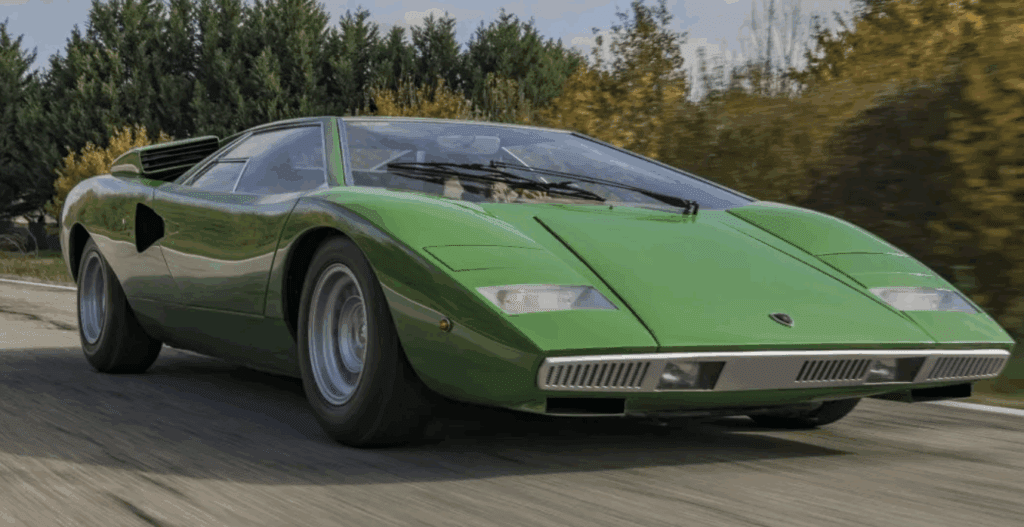
Lamborghini V-12 Supercars Ranked – Countach (1974-1990)
The Countach was not the first V12 Lamborghini, but it is the V12 Lamborghini.
It was under its reign that the carmaker went from a bootstrapped operation to a global icon profiled on 60 Minutes.
Most Lamborghinis are named after fighting bulls; only one is named after an exclamation that’s a borderline swear word in its native tongue.
The Countach wasn’t just a car; it was a symbol.
No car has been more closely associated with a decade than the Countach is with the greed-is-good cocaine-fueled excess of the 1980s, but its story actually started almost a decade before in the early 1970s, when Lamborghini’s bigwigs gathered together and decided the aging Miura needed a replacement that would be bolder, quicker, and cure the ails of the original supercar and its backroom origins.
The prototype — designed, like the Miura, by Gandini — first appeared at the 1971 Geneva Motor Show, an impossible doorstop of a spaceship with a roofline that barely came up to the waists of the go-go-boot-wearing models who posed alongside it.
It was pure art, to the point that it lacked many of the features a production car would need, such as mirrors, bumpers, etc. Lamborghini would spend the next three years workshopping the Countach to get it ready for market, but while many of the prototype’s fanciful pieces would be tweaked, the scissor doors remained and would go on to become as much a defining trait of Lamborghini’s V12 models (and the supercar class as a whole) as the low-slung mid-engined body style.
The Countach launched with the same 3.9-liter V12 as the Miura had used, now tuned up to 370 hp and, more notably, rotated to a more traditional longitudinal layout.
In 1978, the car actually lost 25 hp, but it gained the option of a rear spoiler — a look which would largely become identified with the car in the public eye.
The drop in ponies was temporary: the engine was restored to 370 hp when it grew to 4.8 liters in 1982, and then grew again to 5.2 liters and 449 hp in 1985, although emissions rules meant Americans had to live with “just” 420.
Although it stayed in showrooms for 16 years — long enough to learn to drive itself — a little less than 2,000 examples of the Countach were built, but those small number of examples arrived at just the right moment: at the peak of the cultural and socioeconomic influence of the baby boomer generation, and exactly when to ensnare the hearts and souls of the budding Ten X that would define the years to come.
The supercar as we know it, the hypercar as we know it, the sports car as we know it would not exist without the Countach.
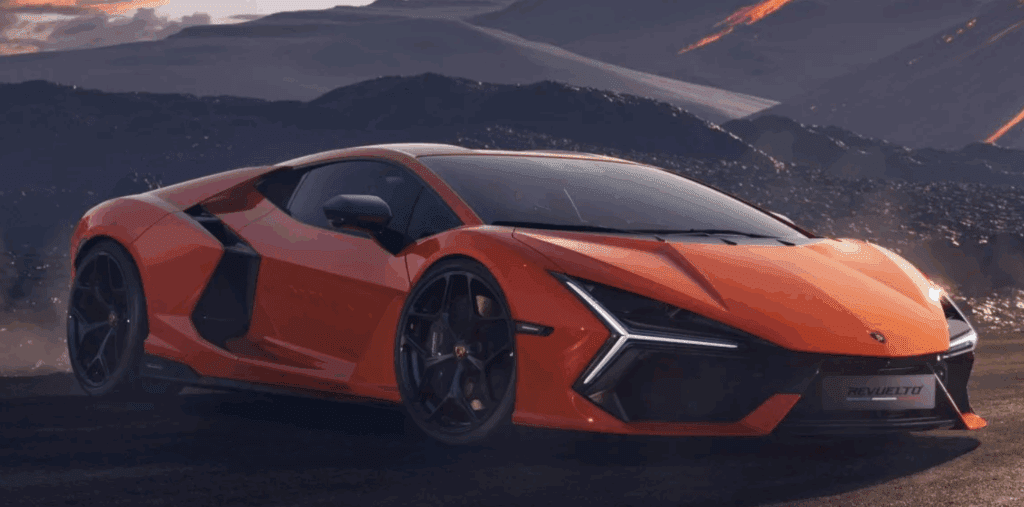
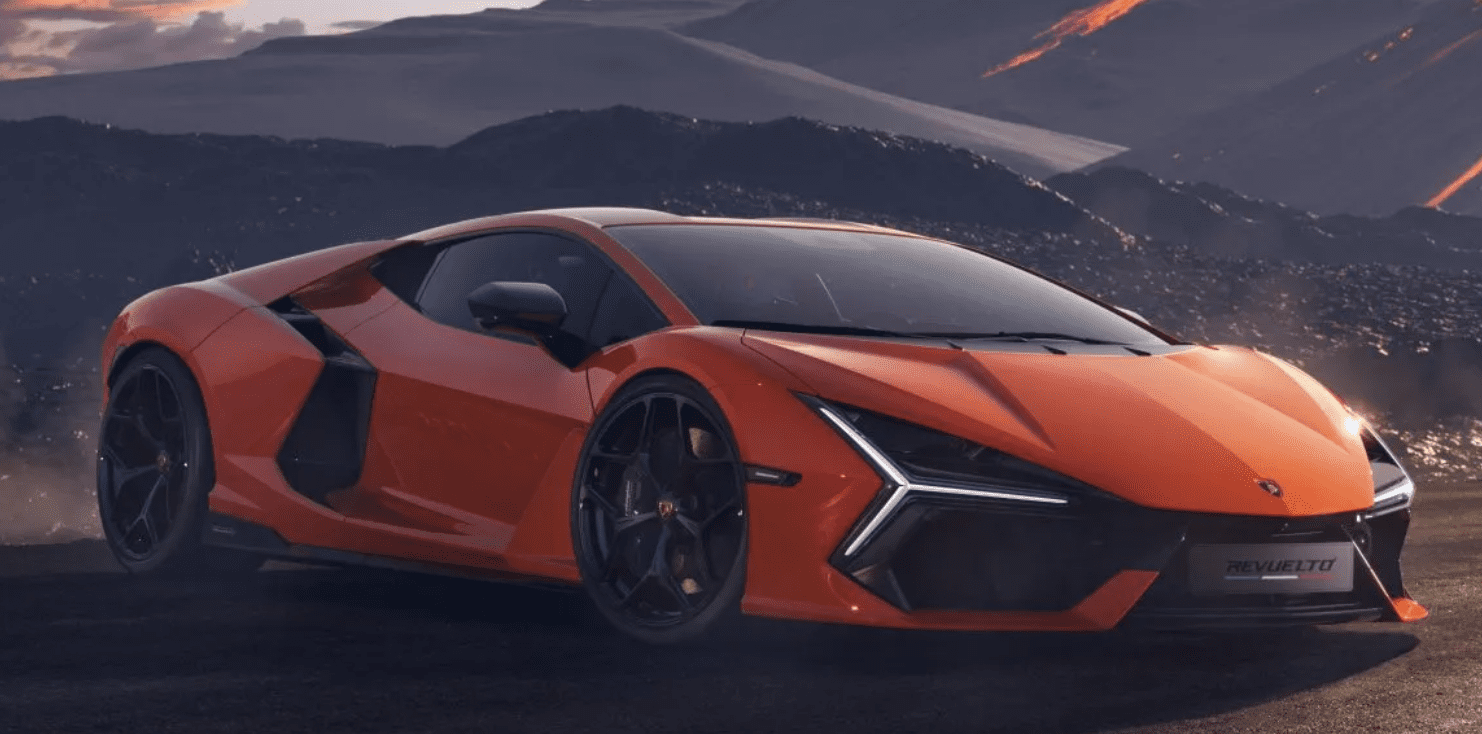
Lamborghini V-12 Supercars Ranked – Revuelto (2023-)
Like all its predecessors, the Revuelto rolled onto the scene packing a naturally aspirated V12 engine.
Indeed, that engine alone would stand as a honey in the automotive pantheon: 6.5 liters of screaming fury, with an absurd redline of 9,400 rpm and making its maximum 814 hp at 9,250.
But the latest 12-cylinder Lambo’s engine has some help that none of its predecessors did: not one but three electric motors, fed by a battery pack that, along with a charge port, makes this Sant’Agata’s first plug-in hybrid.
With one on the transmission housing and one each for each front wheel, the Revuelto can putter about silently on battery power for a handful of miles, should the need arise — a first for a Lamborghini supercar.
The result is the first Lambo to reach a four-digit horsepower output; the company officially rates it as 1,001 hp, but the carmaker’s own representatives admit every example comfortably makes more than that.
The numbers don’t do justice to the way the four power sources play together, however, delivering a seamless rush of force as the electric motors perfectly fill in the gaps in the engine’s power band, combining the immediacy of an EV with the emotionality of a high-revving V12.
The Revuelto proved that, even in the face of a future where electric propulsion can put racecar-like acceleration in the hands of the masses, there’s still a path to putting out ridiculous power that feels special.
It also broke new ground in terms of everyday livability.
A dual-clutch eight-speed automatic gave the car both quicker shifts and a gentler ride when puttering around in automatic mode, while the cabin actually provides decent headroom and legroom even for tall adults, and a spot for a golf bag behind the seats to boot.
Yet in spite of all this, it’s even more wild-looking than its predecessors, taking the angularity of the Aventador and turning it up to 11 with features like barely visible headlights behind massive tri-pointed running lamps and an engine that’s exposed to the sun and rain.
No one who saw a Revuelto would believe how easy it is to drive; no one who drove one gently around the block would believe the fury it’s capable of when uncorked. It contains multitudes — in a way, previous V12 Lamborghinis simply did not.
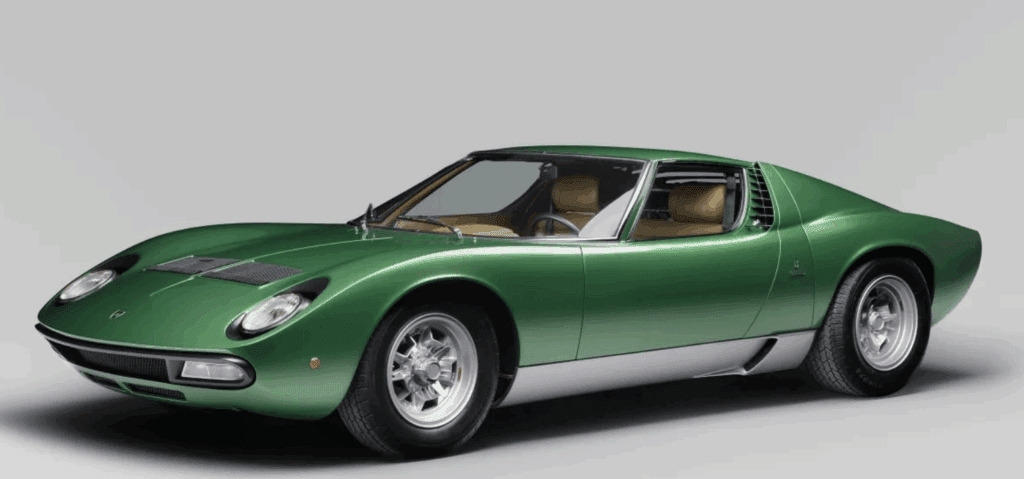
Lamborghini V-12 Supercars Ranked – Miura (1966-1973)
The third model to ever wear a raging bull on its hood, the Miura wasn’t even supposed to exist.
It was created on the side by a gaggle of engineers who wanted to see what the company that Ferruccio Lamborghini had created to build road cars could do if they turned their minds towards something more track-oriented.
By modern standards, the Miura is a simple machine, and also an odd one in some ways. Its mighty 12-cylinder heart is mounted transversely, stretching side-to-side across the chassis instead of the front-to-back layout usually used with engines of more than four cylinders.
That basic packaging was enough to get the car green-lit: when Lamborghini showed the bare chassis and motor at the 1965 Turin Salon, wealthy parties lined up to say shut-up-and-take-my-money in numbers great enough to convince the carmaker to go forth with the project.
It would be the first time a production sports car would adopt the now-classic mid-engined layout; it would not be the last.
But the Miura — and perhaps Lamborghini — would not exist if not for the bodywork designed by a young designer named Marcello Gandini, who was tapped to style the new car for design house Bertone.
It was Gandini’s first car for the company, but not the last; he would go on to pen cars for Lambo for decades, on top of his work drafting icons from the first VW Golf to the Lancia Stratos.
The Miura’s looks were perfectly of their time, yet also timeless: remarkably smooth and sensual, yet with unmistakable currents of fire beneath the skin.
His design perfectly complemented the raw, almost sexual power of the 3.9-liter V12 mounted directly behind the driver, which spat out 345 hp at the time of the car’s launch and reached 380 hp in later editions.
Just as impressive as the performance was the sound it made, a harsh, violent roar that Van Halen would immortalize as a backing track on the song “Panama.” Fewer than 900 road-going Miuras were made, but few other cars built in such small numbers have gone on to change automotive history quite so greatly.
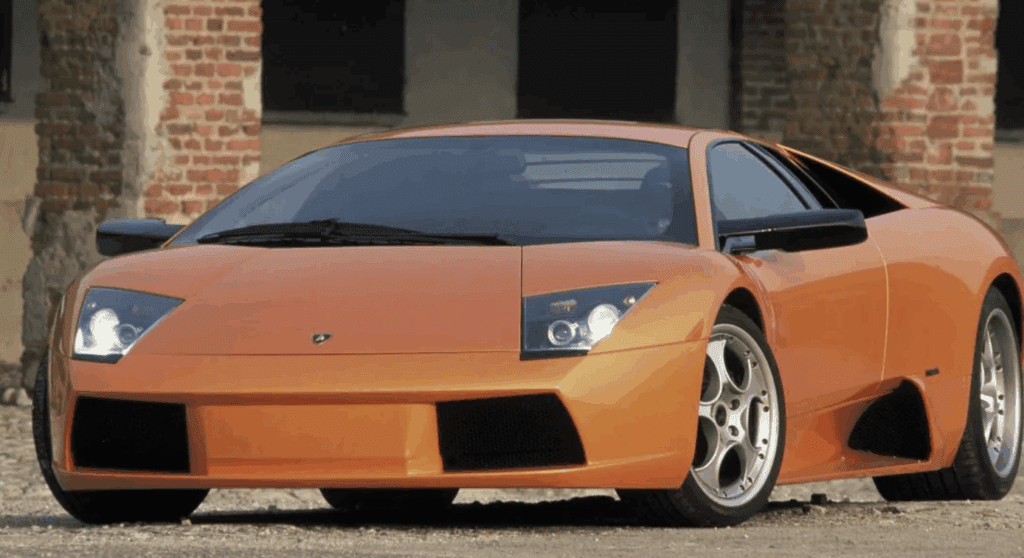
Lamborghini V-12 Supercars Ranked – Murciélago (2001-2009)
An argument could easily be made to swap the Aventador and Murciélago’s places on this list, but the Murci squeaks by primarily on one characteristic: it proved that Lamborghini could be a stable, successful car company.
As the first Lambo made completely under the watchful eye of Audi, it showed that Germanic ownership was far from antithetical to the wild Italian brand. Indeed, access to the VW Group’s materiel and finances turned out to be exactly what Lamborghini needed to thrive.
After more than a decade of the Diablo, Lamborghini was in need of a fresh mid-engined supercar, but it would arrive in a time in which most competitors faded away; even Ferrari had forgone its mid-engined Testarossa for the front-motored 550 Maranello.
The 6.2-liter V12 spat out 572 hp at launch, around 10% more ponies than even the strongest street-legal Diablo had ever made, but by the time the car retired it was putting out 661 hp.
And for the final time, the V12 came connected to a traditional manual gearbox, with buyers having the choice between a six-speed stick shifted via a giant pendulum or a harsh six-speed single-clutch paddle-shifted manual.
Its style was in many ways a refinement of the final run of Diablos, smoothing and polishing the old car’s edges while adding strength and modernity to the design. (One particularly notable specific feature was the engine air intakes behind the doors, which would swing open at speed to suck in extra air at high speed.)
The design’s appearance wasn’t just exotic, it was heroic; indeed, it was so reminiscent of a Batmobile, it seemed all too perfect when Christian Bale’s Bruce Wayne drove one in both Batman Begins and The Dark Knight. Helping matters: Murcielago is the Spanish word for “bat.”
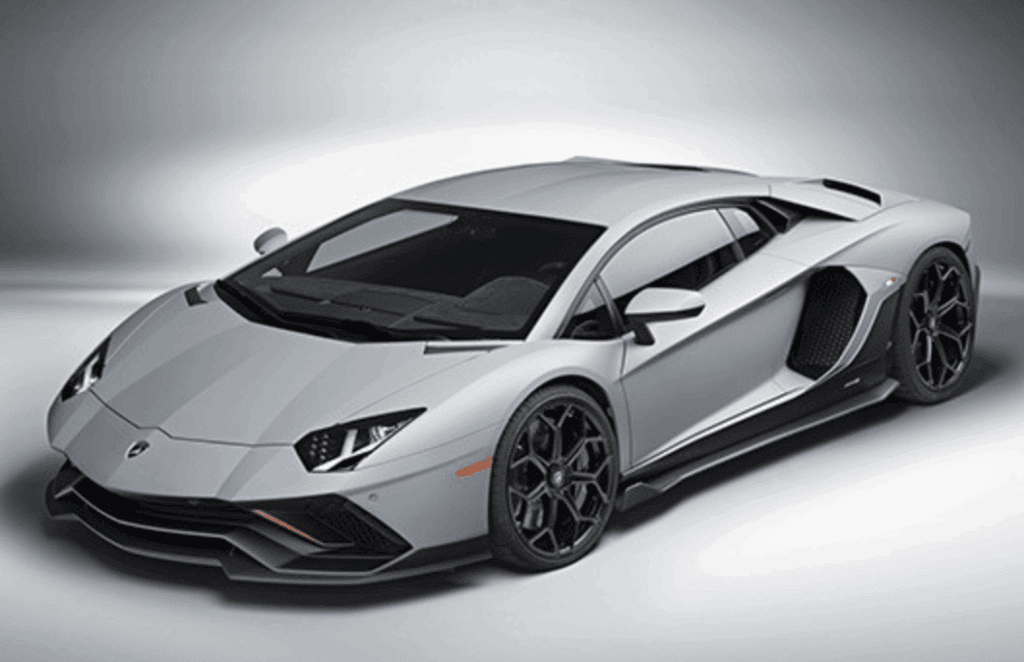
Lamborghini V-12 Supercars Ranked – Aventador (2011-2022)
Plenty of cars can claim to take inspiration from the world of aircraft, but none seem to draw quite so closely as the Aventador and the manner in which it resembles a stealth fighter, from its radar-dodging angles to the afterburner-like exhaust pipe that wouldn’t look out of place on an F-35.
Its 6.5-liter V12 made 690 horsepower at launch, although its metric pony count enabled the first version to formally go by Aventador LP 700-4; by the time production wrapped in 2022, the engine was making 769 hp in the send-off model, the Aventador Ultimae.
Every version, however, was capable of blitzing from 0 to 60 mph in less than three seconds.
The Aventador also saw Lamborghini push the limits of all-around performance a bit farther than previous models, adding a greater emphasis on handling than those that came before.
That culminated in the Aventador SVJ, a bewinged beast that added active aerodynamics on top of extra power to create a machine that massacred the Nurburgring Nordschleife in 6:44.97, beating the best of corporate cousin Porsche — and setting a new production car record along the way.
While the Aventador remains one of the most desirable supercars of the third millennium’s second decade, it had the sad fortune of living through — and remaining largely static — 10 of the most transformational years in automotive history.
When it launched, it seemed a bleeding-edge statement of intent and technological progress, its nearly-700-hp naturally aspirated V12 practically a work of magic.
When it departed, the world was welcoming 2000-hp EVs and 300-mph hypercars, with crude Dodge Challengers outpunching the Lambo.
Few drivers would kick the Aventador out of their garage these days, but collectors seem less likely to seek them out down the road than some of the other cars on this list.
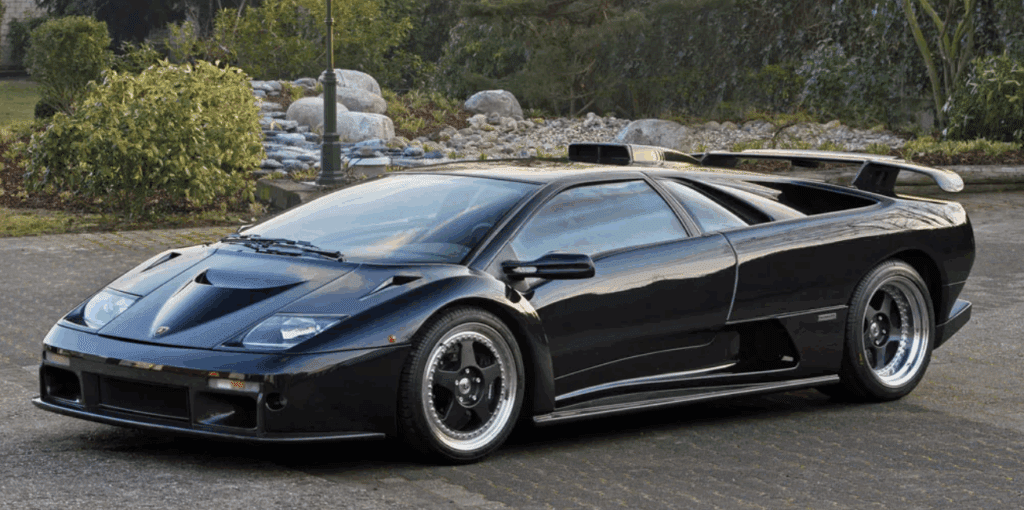
Lamborghini V-12 Supercars Ranked – Diablo (1990-2001)
The world of the early 1990s was rich with wanna-be, almost-was, and barely-were supercars, from the Jaguar XJ200 and Bugatti EB110 to the Vector W8 and the Cizeta V16T.
Yet while most wound up being little more than footnotes in the books, Lamborghini managed to build a new mid-engined monster that would prove a successful successor to its forebears on children’s bedroom walls and in rich men’s driveways alike.
The time of the Diablo’s development and birth was marked by tumult at its parent company.
When the project kicked off in 1985, Lamborghini was being run by a pair of young brothers who’d bought what was left of the dying company in 1981 and were doing their best to move the ball down the field with a successor to the Countach.
By 1987, Chrysler had bought up the brand, putting their own Detroit spin on the new car along the way.
The resulting car that debuted in January 1990 was powered by a 5.7-liter, 485-hp version of Lambo’s familiar V12, but the look was modern for its time, dialing back the 1980s excess for the 1990s much as Jerry Seinfeld did with his hair.
The Diablo did pioneer the concept of adding all-wheel-drive to a Lamborghini with 1993’s Diablo VT, a concept that would go on to spread like wildfire across the company as the engineers realized the potential it had to make the most of potent engines.
Product planners realized the potential in selling four-wheel grip as a performance add-on. (Fun fact: in 2025, Lamborghini has a higher percentage of AWD cars than Subaru.)
Still, the car lacks both the outrageousness of its predecessors and the stomach-churning performance of its descendants.
There’s nothing wrong with the Diablo; it’s simply the least among legends.
Most Expensive Cars in the World >>