Operant Conditioning For Dogs
Operant Conditioning For Dogs – Operant conditioning is the foundation of most modern dog training. It’s based on a simple idea from behavioral psychology.
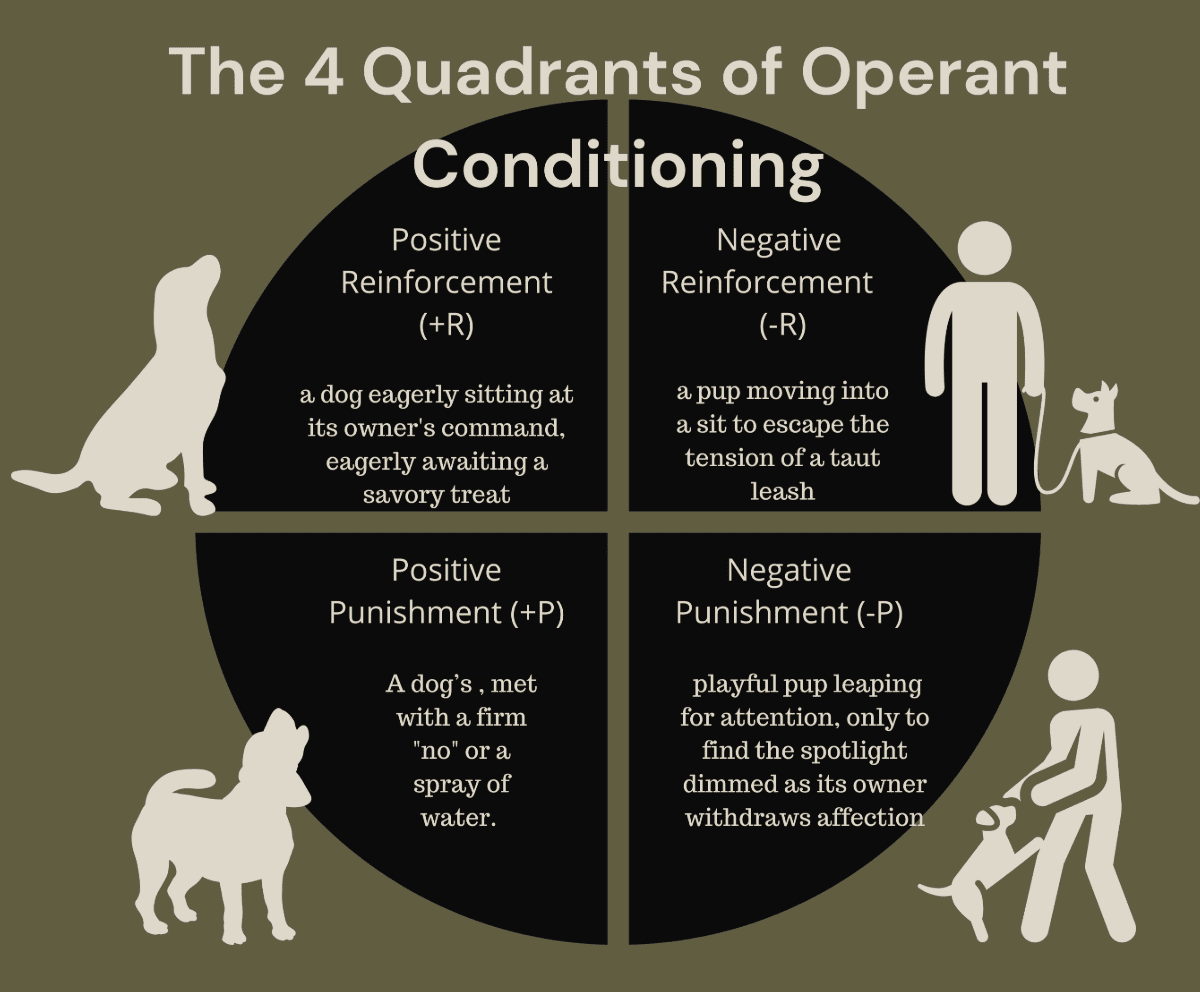
Operant conditioning in dog training uses consequences—rewards or penalties—to increase or decrease specific behaviors through four quadrants: positive reinforcement, negative reinforcement, positive punishment, and negative punishment.
It teaches dogs to associate actions with outcomes, such as receiving treats for sitting (positive reinforcement) or removing attention when jumping (negative punishment).
Basically, behaviors that are reinforced become more likely to happen again; behaviors that aren’t reinforced fade away.
You shape what your dog does by what happens immediately after a behavior.
Operant Conditioning For Dogs – The 4 Quadrants (Core Framework)
Training a dog is not just about teaching basic commands; it is about building a strong bond and effective communication between dog and human.
Teaching the basics of obedience, including skills such as sit, stay, come, and polite leash manners is essential to having a well-behaved dog.
Socialization is another key aspect of a well behaved dog, and should not be overlooked.
This involves exposing your dog to different environments, people, and animals to ensure they are comfortable and well-behaved in various situations.
Addressing behavioral issues such as barking, chewing, and aggression requires patience, consistency, and sometimes the help of a professional dog trainer.
Dogs learn through a process called operant conditioning, a theory developed by B.F. Skinner.
Operant conditioning involves associating a specific action with a consequence.
Positive reinforcement is an effective and preferential method of conditioning, where desired behaviors are reinforced with praise, treats, or play.
This encourages dogs to repeat those behaviors in the future.
Trainers often describe operant conditioning using four consequences.
“Positive” and “negative” here mean adding or removing something — not good vs. bad.
Common Misconceptions
Positive vs. Negative: In this context, “positive” means adding a stimulus, and “negative” means removing one, not “good” or “bad”.
Punishment: Does not necessarily mean harsh treatment; it simply means taking action to decrease a behavior, such as removing a toy.
Using these techniques, owners can shape desired behaviors, such as obedience commands, and eliminate unwanted habits, such as leash pulling or counter-surfing.
Positive Reinforcement
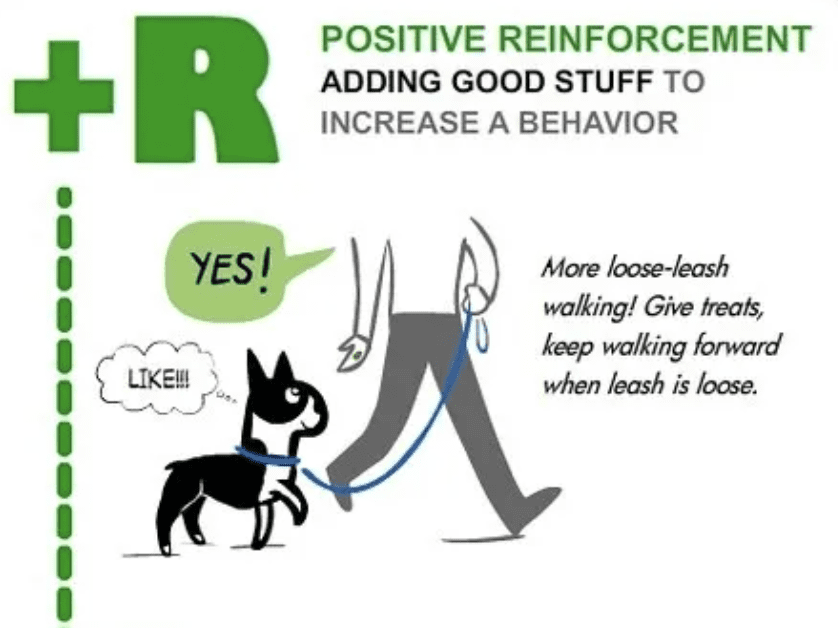
Positive reinforcement is a method that rewards desired behaviors to encourage their repetition.
This can be done using any reward that motivates your dog.
The key is to reinforce the behavior immediately after it occurs, so the dog associates the reward with the specific action.
Positive reinforcement teaches dogs to make positive associations and helps them understand what you expect from them.
It is a gentle and effective method that builds trust and strengthens the bond between you and your dog.
Positive reinforcement is more effective than other training methods because it focuses on rewarding desired behaviors instead of punishing unwanted ones.
This approach encourages dogs to repeat behaviors that are associated with rewards, creating a positive learning experience. When a behavior increases after adding a reward/reinforcer you are using positive reinforcement.
Positive Reinforcement (+R):
his involves adding something desirable to increase the likelihood of a behavior occurring again.
For instance, when a dog sits on command and receives a treat as a reward, the treat serves as positive reinforcement.
The addition of the treat strengthens the association between sitting and receiving a reward, making the dog more likely to repeat the behavior in the future.
Examples of Positive Reinforcement
Add something the dog likes → behavior increases
Give treat when dog sits
Praise when dog comes when called
Toss toy when dog checks in on walk
This is the primary method in modern training because it builds motivation and trust.
Examples
Sit → treat
Eye contact → praise
Loose leash → continue walking
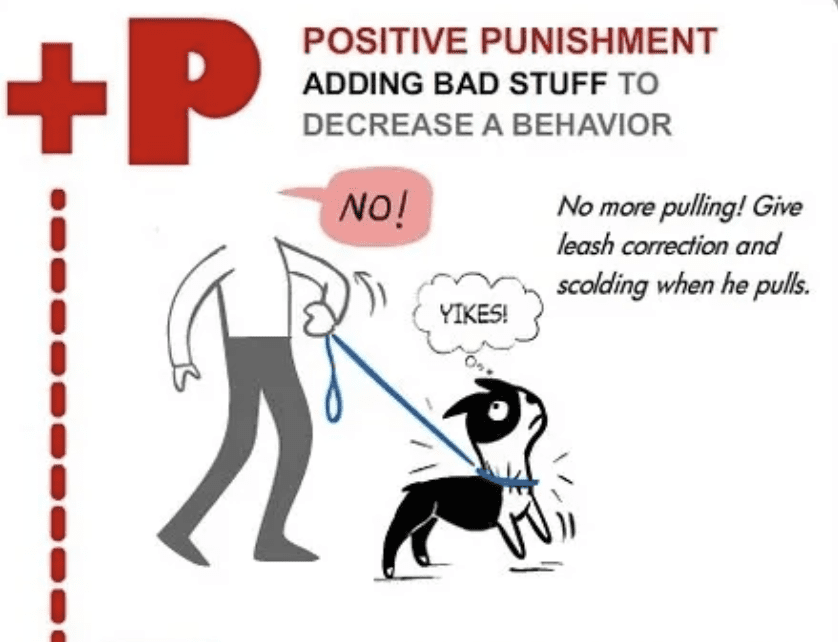
Operant Conditioning For Dogs – Positive Punishment
Positive punishment as it relates to dog training involves adding an aversive consequence to stop or deter an unwanted behavior.
The goal of positive punishment is to reduce the likelihood of a behavior by use of an unpleasant outcome.
Adding an outcome that the dog tries to avoid can reduce the behavior that you are trying to extinguish
Positive Punishment (+P):
This quadrant involves adding an aversive stimulus to decrease the likelihood of a behavior occurring again.
For instance, if a dog barks excessively, and the owner uses a sharp “no” or a squirt of water to stop the barking, these actions serve as positive punishment.
The addition of an unpleasant consequence discourages the dog from repeating the behavior.
Operant Conditioning For Dogs – Examples of Positive Punishment
Add something unpleasant → behavior decreases
Example:
Dog jumps → gets a leash correction
Dog barks → receives spray or loud noise
This can stop behavior quickly but may creat
Negative Reinforcement
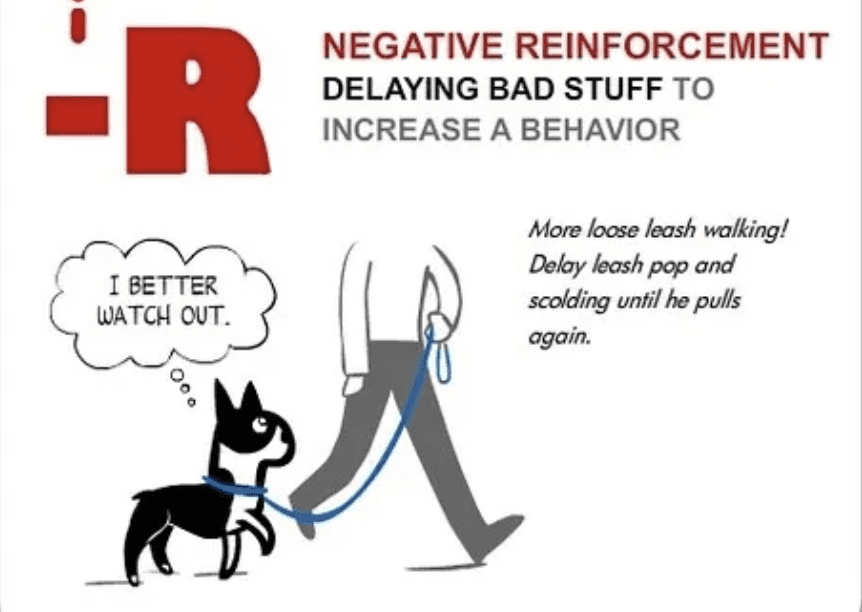
Negative reinforcement in dog training involves the removal of something aversive to the dog to increase the likelihood of a particular behavior recurring.
The goal of this method is to increase a desired behavior by removing something unpleasant when the behavior is displayed.
Negative reinforcement focuses on the cessation of something the dog finds unfavorable rather than its application.
In negative reinforcement, something that the dog finds aversive is discontinued when the dog responds correctly to a cue or command, encouraging the dog to repeat the action on cue to avoid discomfort.
This method focuses on creating an association between the removal of an unpleasant stimulus and the desired behavior, requiring precise timing and consistent application for results.
Negative Reinforcement (-R):
Negative reinforcement involves removing an aversive stimulus to increase the likelihood of a behavior occurring again.
For example, if a dog learns to sit to avoid the discomfort of a tight leash pulling on its collar, the relief from leash pressure serves as negative reinforcement.
By sitting, the dog removes the aversive stimulus (tight leash), reinforcing the behavior of sitting in similar situations in the future.
Examples of Negative Reinforcement
Remove something the dog wants → behavior decreases
Often very effective and humane.
Examples
Dog jumps → you turn away (attention removed)
Dog mouths → play stops
Dog pulls → walk stops
The dog learns: that behavior makes good things disappear.
Timing: the Most Important Factor
Dogs connect consequences to behavior within about 1–2 seconds.
If timing is off, the dog learns something else.
That’s why trainers use markers like:
Clicker
“Yes!”
“Good!”
These precisely tell the dog: that behavior right there earned the reward.
Operant Conditioning For Dogs – Negative Punishment
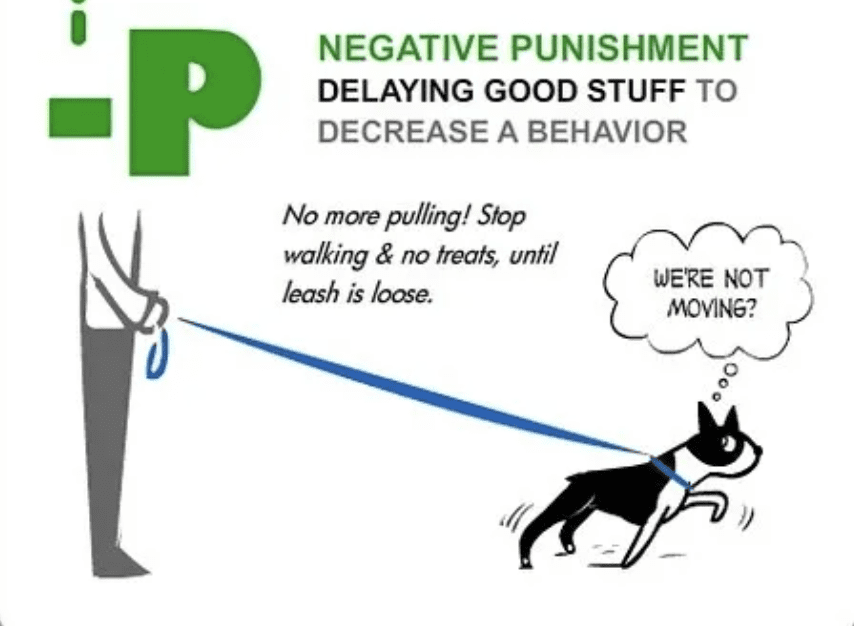
The concept of negative punishment involves the removal of something desirable to decrease the likelihood of unwanted behaviors recurring.
It operates by taking away something pleasant when an unwanted behavior is exhibited.
This method seeks to reduce the frequency of an undesired behavior by associating it with the removal of something that is desired by the dog.
Negative Punishment (-P):
Negative punishment entails removing something desirable or delaying gratification to decrease the probability of a behavior.
An example in dog training is when a dog jumps on people for attention, and the owner ignores the dog until it stops jumping.
By withholding attention, the owner removes a desirable stimulus, decreasing the likelihood of the dog jumping in the future.
Operant Conditioning For Dogs –Examples of Negative Punishment
Remove something unpleasant → behavior increases
Often misunderstood. It doesn’t mean punishment — it means relief motivates behavior.
Examples
Pressure on leash stops when dog walks beside you
Gentle pressure on harness released when dog sits
This is common in traditional training but must be used carefully to avoid stress.
Couch Potato Puppy Dog Breeds >>